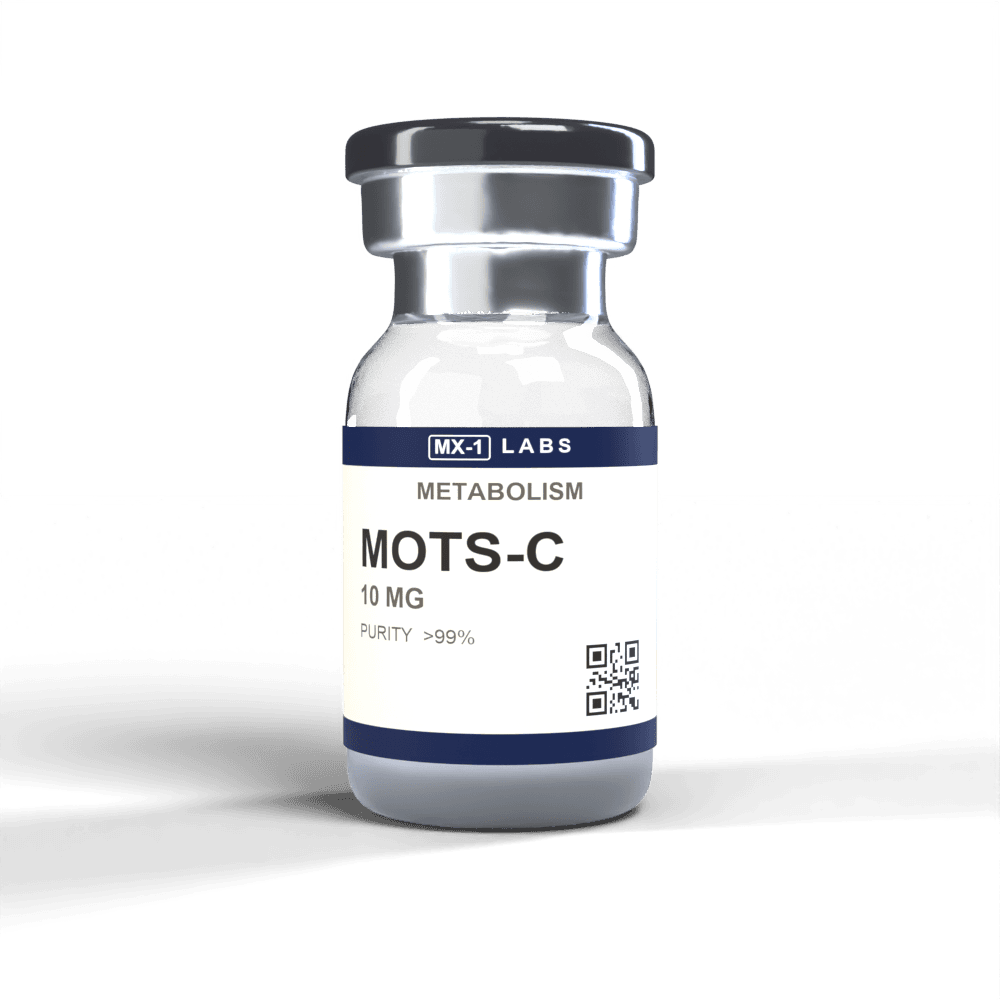
- CAS#
- 1627580-64-6
- Formula
- C100H152N28O22S
- M.W.
- 2,174.62 g/mol
- Sequence
- MRWQEMGYIFYPRKLR
Ships in 24–72 business hours from CDMX · Free shipping over MX$2,500.00
MOTS-c 10 mg is a lyophilized research compound, ≥99% purity verified by HPLC with identity confirmed by mass spectrometry. Every batch ships with a traceable Certificate of Analysis (CoA).
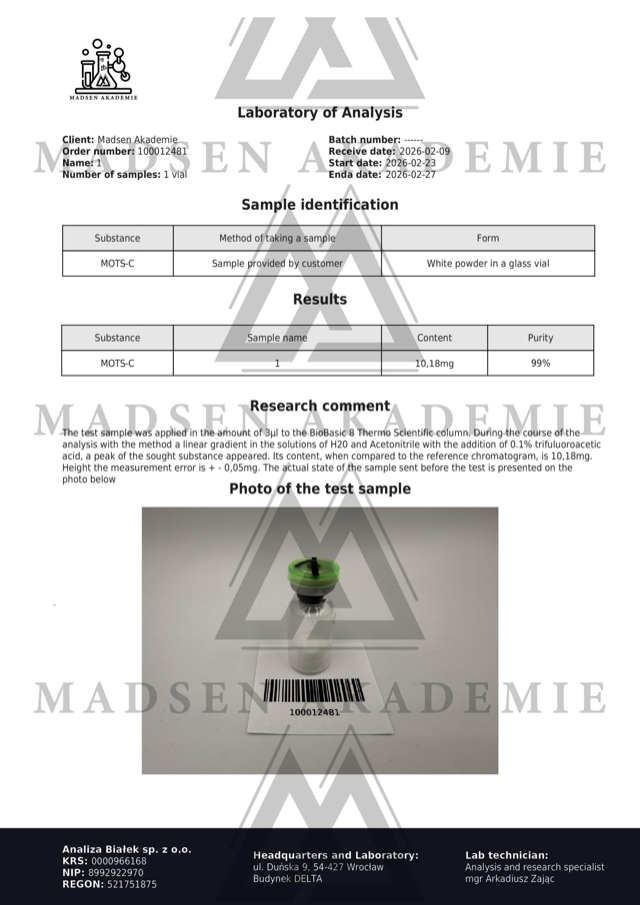
Certificate of Analysis
- Lot
- 100012481
- Expires
- 2028-02
- Chromatographic purity
- ≥99%
- Content
- 10.18 mg
- Analyzed by
- Madsen Akademie · 2026-02
Preview COAHide preview
- CAS#
- 1627580-64-6
- Formula
- C100H152N28O22S
- M.W.
- 2,174.62 g/mol
- Sequence
- MRWQEMGYIFYPRKLR
- Lot
- 100012481
- Expires
- 2028-02
- Chromatographic purity
- ≥99%
- Content
- 10.18 mg
- Analyzed by
- Madsen Akademie · 2026-02
Preview COAHide preview
MOTS-c 10 mg is a lyophilized research compound, ≥99% purity verified by HPLC with identity confirmed by mass spectrometry. Every batch ships with a traceable Certificate of Analysis (CoA).
Ships in 24–72 business hours from CDMX · Free shipping over MX$2,500.00
Technical specifications
- Molecular weight
- 2,174.62 Da
- Sequence
- MRWQEMGYIFYPRKLR (16 aa)
- Format
- Sterile lyophilized
- Content
- 10 mg per vial
- Purity
- ≥99% verified by HPLC in batch CoA
- Identity
- Confirmed by MALDI-TOF MS
- Genomic origin
- Mitochondrial DNA (12S rRNA)
- Endotoxins (LAL)
- < 5 EU/mg
- Water content (Karl Fischer)
- < 6%
- Amino acid analysis
- Composition confirmed by acid hydrolysis
About MOTS-c 10 mg
MOTS-c (Mitochondrial Open Reading Frame of the 12S rRNA Type-c) is a synthetic 16-amino-acid peptide (sequence MRWQEMGYIFYPRKLR) with a molecular weight of 2,174.62 Da. What makes it unusual is its genomic origin: the sequence is encoded inside human mitochondrial DNA, within the 12S rRNA reading frame — making it one of the first mitochondrial-derived peptides characterized with documented systemic hormonal function.
Lee and colleagues published the original discovery and analytical characterization in Cell Metabolism (2015), based on work done at the University of Southern California [1]. Functional characterization was later expanded by Reynolds and colleagues in Nature Communications (2021) on exercise-dependent regulation in animal models [2].
MX-1 Labs distributes MOTS-c 10 mg in Mexico as a scientific research compound in sterile lyophilized format, with complete per-batch analytical documentation. Analytical traceability is maintained from protected amino acids through the final lyophilized vial; per-batch retention samples are held by the synthesizing lab under their GMP program and are available for audit. The product is intended exclusively for in vitro laboratory research and authorized preclinical models; it is not a medication, supplement, or consumer product.
Research applications
In preclinical in vitro and in vivo rodent models, MOTS-c is associated with activation of AMPK (AMP-activated protein kinase), the cell's master energy sensor, per the original characterization published by Lee et al. in Cell Metabolism [1]. Modulation of the folate metabolism pathway and regulation of metabolic homeostasis are also documented in the foundational paper and the follow-up by Reynolds et al. in Nature Communications [2], which reports exercise-dependent regulation of the peptide in animal models with age-associated physical decline. The specific experimental application is the responsibility of the receiving lab and its authorized institutional SOP.
Storage and handling
Sealed vial of MOTS-c 10 mg: store in a controlled environment, protected from humidity, direct light, and thermal variation. Once the experimental solution is prepared with the diluent specified in the lab's SOP, keep refrigerated under documented conditions when the protocol requires it and avoid repeated freeze-thaw cycles. Discard the material at any sign of turbidity, suspended particles, or loss of the original lyophilized appearance.
Scientific references
- Lee C et al. The Mitochondrial-Derived Peptide MOTS-c Promotes Metabolic Homeostasis. Cell Metabolism 2015; 21(3):443–454. View source on PubMed →
- Reynolds JC et al. MOTS-c is an exercise-induced mitochondrial-encoded regulator of age-dependent physical decline. Nature Communications 2021; 12:470. View source on PubMed →
Frequently asked questions
What's included in the MOTS-c 10 mg vial?+
A sterile lyophilized vial containing MOTS-c 10 mg (synthetic 16-amino-acid peptide, sequence MRWQEMGYIFYPRKLR), shipped with the batch-specific Certificate of Analysis (CoA) — the batch number on the vial is auditable against the independent analytical lab.
What purity is guaranteed?+
≥99% verified by high-resolution reverse-phase HPLC with full chromatogram. Identity is confirmed by MALDI-TOF MS, and amino-acid, water (Karl Fischer), and endotoxin (LAL) controls are also reported.
Why is MOTS-c considered a mitochondrial peptide?+
Because its sequence is encoded inside human mitochondrial DNA, within the 12S rRNA gene reading frame. It is one of the first mitochondrial-derived peptides characterized with systemic hormonal function, discovered by Lee and colleagues in Cell Metabolism (2015).
How should the sealed vial be stored?+
Store in a controlled environment, protected from humidity, direct light, and thermal variation due to the peptide's sensitivity. Stability of prepared solutions depends on the specific CoA, the SOP diluent, and the receiving lab's institutional protocol. Avoid repeated freeze-thaw cycles.
Is it legal to buy MOTS-c in Mexico?+
Yes, as a scientific research compound for experimental use in vitro and in authorized preclinical models. It is not a medication, supplement, or consumer product, and it is not approved by COFEPRIS for those uses.
How long does shipping take, and is there free shipping?+
1–4 business days depending on destination within Mexico (1–2 north, 2–3 center, 3–4 south) via Estafeta, FedEx, or DHL. Free shipping on orders over $2,500 MXN. We do not ship internationally.
Where can I buy MOTS-c in Mexico?+
MX-1 Labs distributes MOTS-c for scientific research throughout Mexico: ≥99% purity verified by HPLC, a batch-specific Certificate of Analysis (CoA) with an auditable lot number, and nationwide shipping from CDMX in 1–4 business days. For laboratory research only; not for human consumption.
Is it legal to buy research peptides in Mexico?
Yes. Research peptides are sold legally in Mexico strictly for laboratory research use — not for human or veterinary consumption, diagnosis, or treatment. MX-1 Labs sells for research purposes only; at checkout you confirm compliant use under applicable law (COFEPRIS) and your lab's protocols. Nationwide shipping from CDMX.
Reviews
- 5 ★3
- 4 ★1
- 3 ★0
- 2 ★0
- 1 ★0
- PNPaola N.✓ Verified purchaselast month
Vial sellado, etiqueta con lote y caducidad claras. El COA coincide con lo recibido.
lot · MOTS-2026-C01 - LELuis E.✓ Verified purchase2 months ago
Buen empaque con refrigerante. Entrega a CDMX en 3 días hábiles.
- GPGabriela P.✓ Verified purchase3 months ago
Pureza HPLC por arriba del 99% según el certificado. Liofilizado uniforme.
- HZHéctor Z.✓ Verified purchase5 months ago
Segundo lote que pido, consistente. Atención por WhatsApp muy rápida.
lot · MOTS-2026-B04
Other research peptides
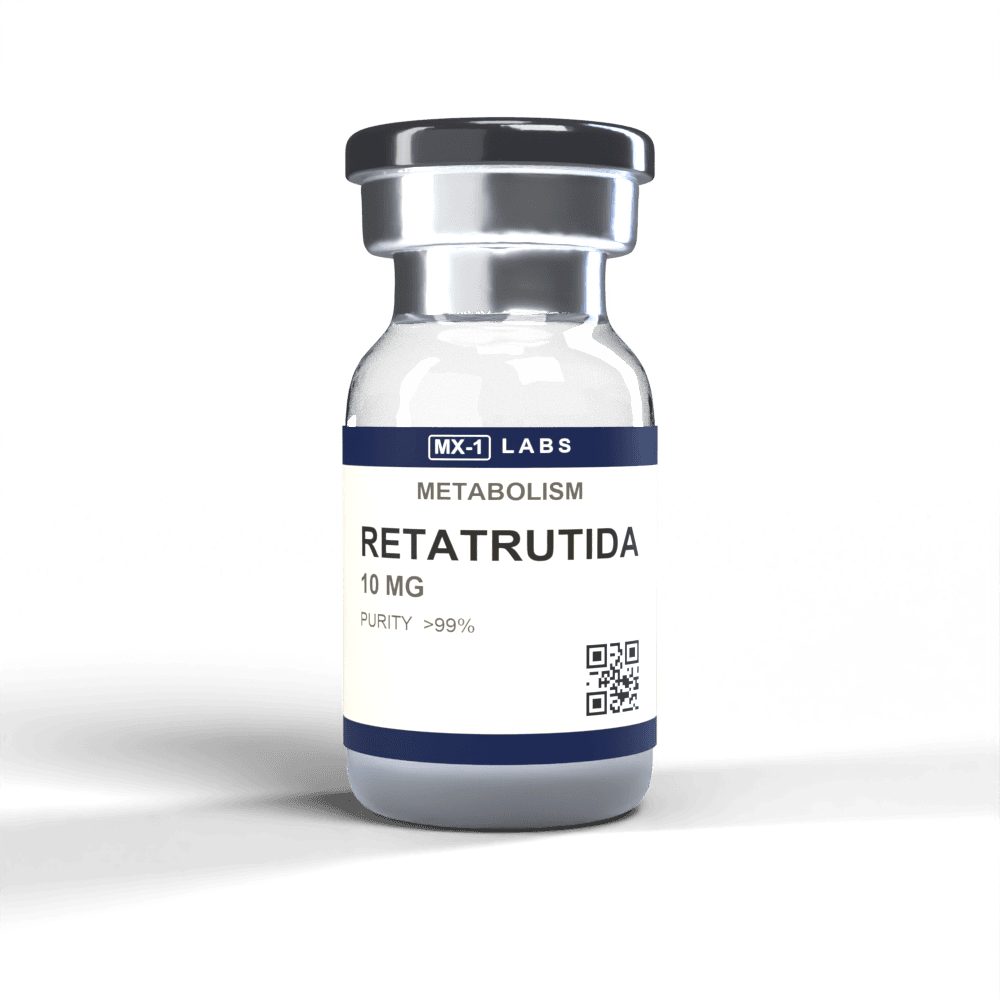 Analyzed in the USAAvailable
Retatrutide
Triple GIP/GLP-1/Glucagon agonist · Metabolism
4.5(6)FromMX$949.00
View product5 · 10 · 15 · 20 mg · For research
 Analyzed in the USAAvailable
Tirzepatide
Dual GIP/GLP-1 agonist · Metabolic
4.8(4)MX$1,399.00
View product10 mg · For research
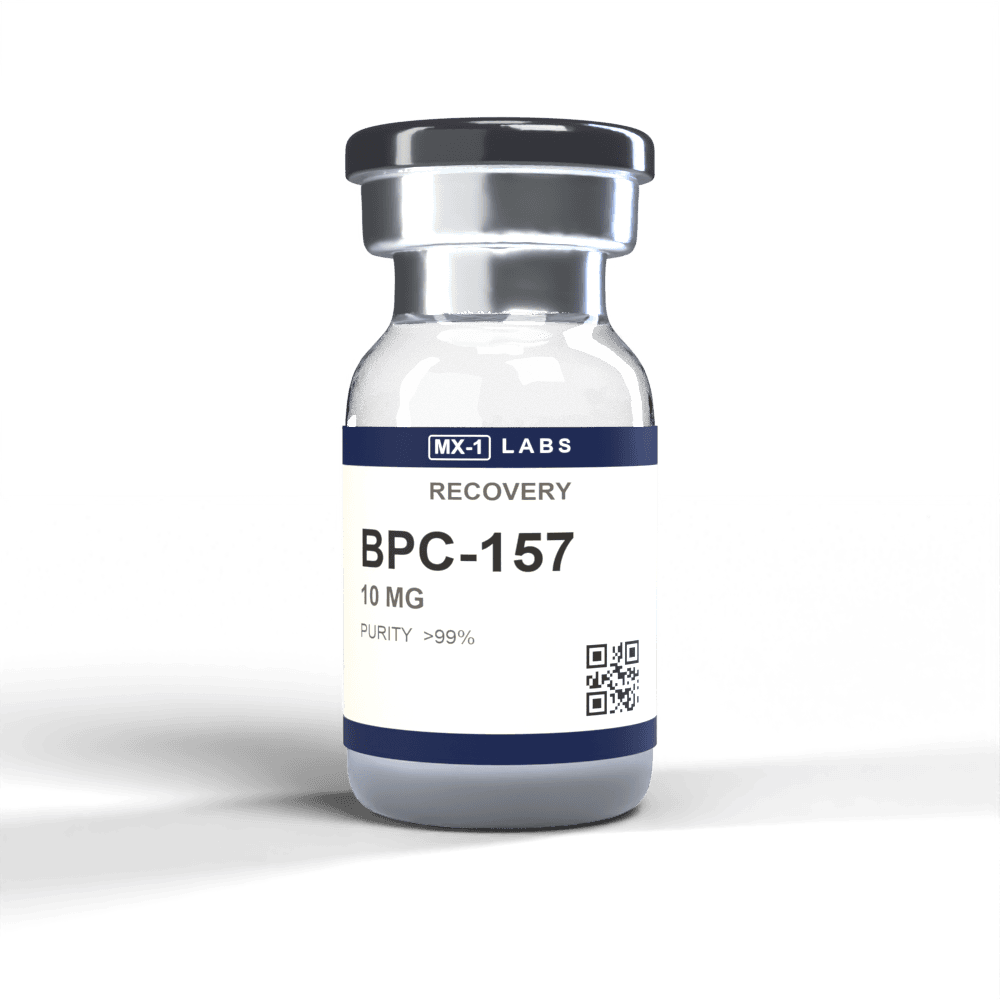 Analyzed in the USAAvailable
BPC-157
Pentadecapeptide · Regeneration
4.6(5)FromMX$673.00
View product5 · 10 mg · For research
 Analyzed in the USAAvailable
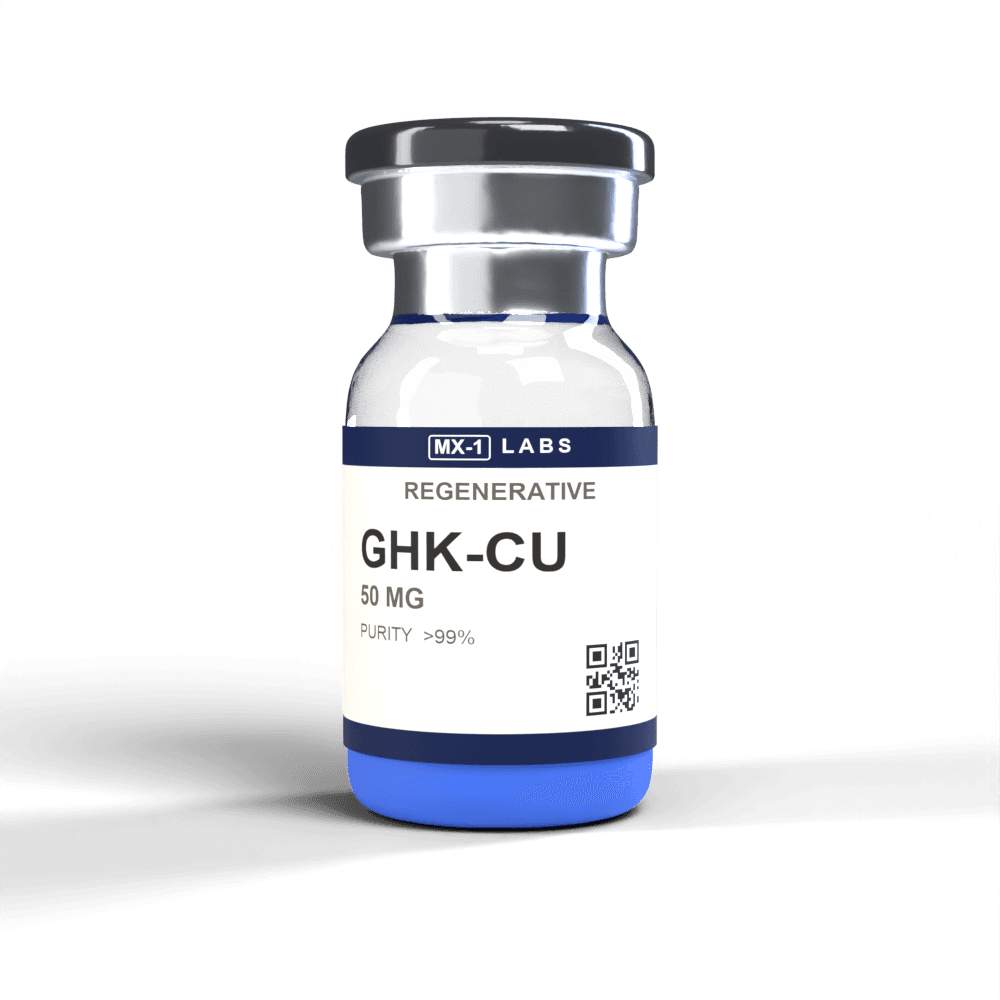
GHK-Cu
Copper tripeptide · Dermatology
4.8(4)MX$518.00
View product50 mg · For research